

This post is free for all subscribers. If you’ve been encouraged by the content of this newsletter, and if you’d like complete and unending access to the huge archive of biblical theology articles, I hope you will consider becoming a supporter this year. Your support is a blessing and a great encouragement!
Over on the Westminster Books site, Banner of Truth’s 5-volume set of Thomas Watson’s works is on sale. And check out Stephen Yuille’s outstanding devotional books called The Sight of Christ and The Fullness of Grace, each containing 90 devotions that incorporate gold from the Puritans. If you find some books you like, use “CHASE” as a promo code for checkout for an even lower total.
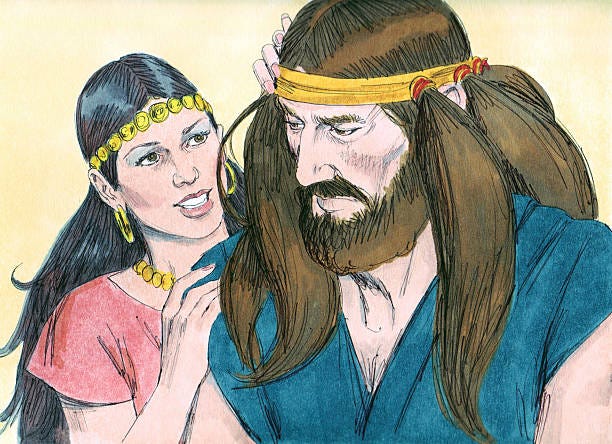
We know that Samson is going to be someone significant, because his birth is announced ahead of time by an Angel of the Lord to a barren woman, who then told her husband what the heavenly messenger had said (Judg. 13). That is not a normal experience with the people in the Bible. In fact, it sounds like the kind of things we’d read in the Gospels!
And yet, in Judges 13, we read about the preparation not for the Messiah but for a deliverer named Samson. All of this chapter is his birth narrative. This kind of leadup really raises the expectations for the reader. What kind of incredible courage will he display? What manly virtue will characterize him? What incredible devotion will he exhibit?
Well, prepare to be disappointed. When you think of Samson, what picture do you have in your mind? How do you describe his character? Does his extraordinary strength make you think he is virtuous? Do his victories make you think all of his actions are justified? Does the fact that his name appears in Hebrews 11 make you think the biblical author endorses what Samson does?
We need to think carefully about this last judge of the book. The biblical author certainly wants us to think a lot about Samson, because Samson gets more attention in the book of Judges than any other judge. Four chapters! Judges 13, 14, 15, and 16.
In Judges 14, his exploits begin (or, at least the exploits we know about).
Samson goes to Timnah, near Philistine territory. He sees a daughter of the Philistines and tells his parents, “I saw one of the daughters of the Philistines at Timnah. Now get her for me as my wife” (Judg. 13:2).
Sounds like Samson wants to marry someone whom he knows is outside the covenant community. The Philistines were currently ruling over part of the Israelites (see Judg. 15:11), so he’s actually talking about taking a daughter of Israel’s enemies. Samson’s parents push back (14:3). After all, the Torah forbids marrying the idolaters of the land (Deut. 7:1–5). Why doesn’t this Nazirite-from-birth want to keep God’s law?
We certainly don’t like Samson’s reasoning: “for she is right in my eyes” (Judg. 14:3). Uh oh. We know that kind of language appears as a refrain later in the book of Judges (see 17:6; 21:25). We think, “No, Samson, don’t think like that. Don’t make decisions that way!”
Our instincts are not infallible. Samson, however, is instinct-driven. His desires steer him. He wants what he wants, and what he wants is this Philistine woman. He ignores Deuteronomy 7:1–5 and violates the 5th Commandment.
The time came to travel to the Philistine woman. He and his parents made the trip to Timnah, and along the way, a young lion roared at him near some vineyards. Samson tore the lion apart, like it was nothing (Judg. 14:6). But later, when he returned to the vineyards of Timnah, he saw the lion carcass, and it now contained bees and honey. Ignoring the Nazirite vow’s prohibition of contact with dead bodies (Num. 6), Samson scooped out honey and ate it, and he even gave some to his parents without telling them where he got it (Judg. 14:9).
Samson, again driven by desire, took what he wanted. He disregarded his vow, and he didn’t bother telling his parents, because he didn’t care how his actions affected them either.
Samson prepared a wedding “feast” (Judg. 14:10), another word for a big drinking party to celebrate his wedding. Such festivities were filled with temptation, because Nazirites were to abstain from wine and any juice from grapes (Num. 6), and it’s hard to imagine that Samson threw a big drinking party yet made sure to keep his vow.
At the feast, he told a riddle (probably with a raised glass and slurred speech) to a group of thirty companions, and he was angry when they ended up giving the answer (Judg. 14:10–18). His wife had told the companions, so he was livid. He left angry, going to his father’s house without his wife (14:19). Furthermore, Samson’s wife was given to one of his companions—his best man (14:20).
What a mess! The chapter is laying out the folly of doing what is right in your own eyes. It is showing the callousness of Samson against the law of God, against his Nazirite vow, and against his own parents.
Does Samson want to do what is honoring to the Lord? Does he want to worship Yahweh? The reader is concerned, and rightly so.
Samson has the strength to tear apart a lion, but he’s not morally calibrated enough not to tear his own life apart. What is Samson’s big problem in Judges 14?
Samson’s biggest problem is not his mom and dad.
His biggest problem is not the lion that roared against him.
His biggest problem is not the unnamed Philistine woman whom he marries.
His biggest problem is not the thirty companions who join him for the wedding.
Samson’s biggest problem is. . . Samson. It’s the man in the mirror.
Samson is physically strong, but he is morally weak. He is externally impressive, but he is internally unsubmissive.
He is lustful, impulsive, and vindictive. These things do not produce a stable man. They produce a deluded, reckless, self-destructive man.
Our biggest problem is not someone outside of us. It’s not our parents or teachers. It’s not our children or coworkers. The biggest problem in our spiritual lives is the person in the mirror. The biggest threat to our faithfulness is our own indwelling sin.
Therefore, Jesus says, “If anyone would come after me, let him deny himself and take up his cross daily and follow me” (Luke 9:23).