
Disrupted by the Mob
Lamenting What Happened at a Minnesota Church

This post is free for all subscribers. If you’ve been encouraged by the content of this newsletter, and if you’d like complete and unending access to the huge archive of biblical theology articles, I hope you will consider becoming a supporter for 2026.
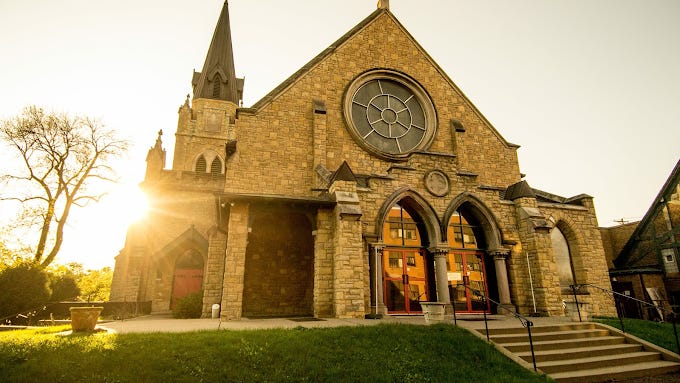
Maybe you’ve heard the news by now, or even seen the video footage, of what happened at Cities Church in St. Paul, Minnesota yesterday (January 18, 2026). A mob of ICE protestors stormed the morning service of Cities Church, whose pastors include folks like Jonathan Parnell and David Mathis—faithful men who love Jesus, the Word of God, and the church of Christ.
Exercising their God-given freedom of religious assembly and worship, Cities Church had gathered on the Lord’s Day as they normally do. And then, violating this God-given and constitutionally-protected right, dozens of protestors trespassed into their sanctuary. What happened was a horrible spectacle, as these belligerent and loud protestors sought to bring disruption and intimidation.
To be clear, the mob’s activities were illegal. They violated the first-amendment protections of Cities Church, but they also refused to leave after trespassing. Even though the public may enter a place of worship to participate, people may not repurpose a place of worship for their own agenda. A church remains a private space. In other words, while people from the public may enter a church to participate in the reasons for its gathering, a place of worship remains a private location that must not become a place of disruption and disorder.
When God’s people gather, what takes place is holy, because their God is holy and the saints are a holy people. An invasion of protestors is a desecration, a profanation, of a holy service. And what happened in St. Paul on January 18th should disturb Christians and law-abiding citizens. The disruption was wicked, illegal, and unconstitutional.
If a handful of protestors behaved unlawfully in a church service, church members—and especially a security detail—would be well within their rights (both ethically and legally) to forcibly remove them. The problem escalates, of course, when dozens of people swarm a church service. The intent is to overwhelm and intimidate. The effect on adults, and especially on children, could be traumatizing.
Churches of Jesus Christ should be able to assemble for worship without having to worry about or experience the disruption of anti-ICE activists. As believers in Jesus, we can think about Cities Church and our own churches in several ways.
First, lament the spectacle that took place at Cities Church. Fellow brothers and sisters in Christ faced the sudden and scary and overwhelming presence of antagonists. A place of worship became a scene of political protest (Matt. 21:13).
Second, pray for the leaders and members of Cities Church. Pray that they will have wisdom and courage and conviction and unity as they gather again. Pray that any fear will not overcome the greater resolve to join in public worship with the people of God.
Third, publicly and privately urge law enforcement to defend the rights of Cities Church. The protestors should be identified and prosecuted. There should be zero tolerance for the flagrant display of lawlessness and desecration that took place in a church. Governing authorities should promote what is good and deter what is evil (Rom. 13:1–4; 1 Tim. 2:1–4).
Fourth, have conversations with your own church’s leaders and members about how you all would respond to such an event if it happened where you worship. Think about your church’s security measures and security team. Be diligent and vigilant.
Fifth, pray for activists like those who invaded Cities Church. Pray that God would grant repentance and peace and self-control to those who seek to provoke and intimidate Christians. Pray for those who persecute you, Jesus said (Matt. 5:44).
Sixth, remember the beatitudes. Jesus said, “Blessed are you when others revile you and persecute you and utter all kinds of evil against you falsely on my account” (Matt. 5:11). Peter says, “Let none of you suffer as a murderer or a thief or an evildoer or a meddler. Yet if anyone suffers as a Christian, let him not be ashamed, but let him glorify God in that name” (1 Pet. 4:15–16).
Seventh, don’t ignore measures of protection as earthly citizens. For example, when Paul was arrested, he appealed to Caesar, and thus was shipped to Rome. His appeal was rooted in what he could leverage as a Roman citizen (Acts 25:11–12). In our present day, leveraging legal measures to protect churches and prosecute criminals is not anti-Christian or anti-neighbor. Rather, such measures exist to promote good and deter evil.
In the opening verses of John’s Gospel, the author gives us really good news: “The light shines in the darkness, and the darkness has not overcome it” (John 1:5).
May the light of Christ shine brightly from Cities Church.